วันพุธที่ 3 สิงหาคม พ.ศ. 2554

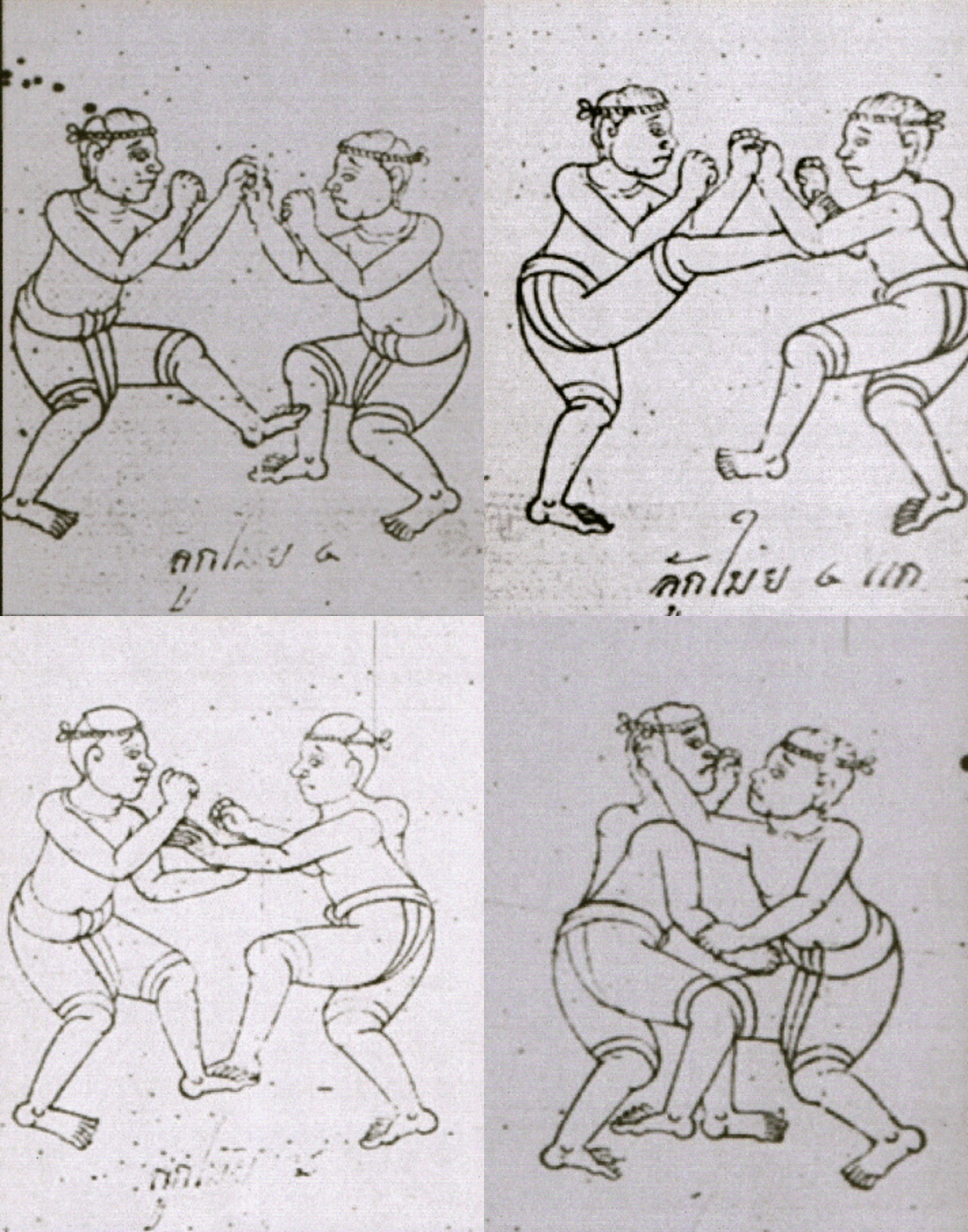
LUK MAI MUAY THAI ลูำกไม้มวยไทย

LUK MAI MUAY THAI


http://cdn.gotoknow.org/assets/media/files/000/461/923/original_anigif.gif?1285725293

                     15 MINOR TECHNIQUES


1   Erawen Soei Nga  เอราวัณเสยงา
     
2   Bata Loop Pak  
บาทาลูบพักตร์
     
3   Khun Yak Pa Nang  
ขุนยักษ์พานาง
     
4  Pra Ram Nao Sorn 
พระรามน้าวศร
   
5  Krainsorn Kham Huai
ไกรสรข้ามห้วย
   
6  Kwang Liew Lang 
กวางเหลียวหลัง
   
7  Hiran Muan Paen Din 
หิรัญม้วนแผ่นดิน
   
8  Naga Mood Badan 
นาคมุดบาดาล
   
 Hanuman Tawi Waen
หนุมานถวายแหวน
   
10 Yuan Tod Hae 
ญวณทอดแห
   
11 Tayaae Kam Sao 
ทะแยค้ำเสา
     
12 Hong Peak Hag 
หงส์ปีกหัก
     
13  Sak Puang Malai 
สักพวงมาลัย
     
14 Tel Kwad Larn 
 เถรกวาดลาน
     
15 Fun Luk Buab 
ฝานลูกบวบ


เอราวัณเสยงา Erawen Soei Nga
Elephant thrusting its tusks
Mae Mai Muay Thai is similar to lace. เถรค้ำฝัก
Offense left straight punch to the face of the party were received.Step with left foot forward, right hand controls a chin.
Defensive driving laying around slightly to the left. Dodge a punchto the left of the offense. With a flea dip fleas on control of The offense with a punch left. Turn right along. The punch left a bigswing at the chin of the offense. In an attempt to split the defensiveover my shoulder the offense.


-บาทาลูบพักตร์  Bata Loop Pak
Foot touches the face
Punch by punch cautiously left the offense with the left foot andstep forward. Right-hand control station at the end of the chin.Atrium will be on hand for the left page.
Defensive punch to the left and step left foot forward so that the offense is a big move with a left straight punchI left a lousydefenseRounded the left hand sideOffense to punch it to Ben to the defense of JavaI kick with the foot straight to the elderlyChinof the offense. Or use a foot rub this offense. Instead of kicking thechin. Italic, left standing on the left foot. Flea and cautiously up the chest.


-ขุนยักษ์พานาง Khun Yak Pa Nang
Giant Steals The Girl
Of the offense with a left straight punch, as well as future stepsforward. Flea control is always right chin.
I stepped foot on the defensive. The left foot of the offense. Right arm, left arm raised to ward off the impact and help out theoffense. Along with the speed to close quickly. The Offense of theleft arm wrapped the body (near the waist) of the offense a lift hipsup, I defeated the offense. Down to the ground by the force.Offense loses power or Head may strike the ground.


 -พระรามน้าวศร Pra Ram Nao Sorn
Rama Pulls The Bow String
Lace is used to strike the opponent's elbow.
Offense, defense, or one foot toward the right. With the doubleelbow strike to the head.
Department for foot approached the offense along with The lowerarm is parallel to the ground. The elbow with a pair of the offense.On the other hand punch swing chin Of the offense and foottraces. According to the punch by punch.


-ไกรสรข้ามห้วย Krainsorn Kham Huai
 Tiger Crosses The Stream
Offense of a kick at the end of the chin. By the way I swing withyour right foot straight up.
Avoid a late defensive steps the left foot, right foot, the team's offense leans to the left, standing on the left foot. I meet with the right foot. Leg kick after the team's offense is essentially standing still. Knee. This puts your knees are not.


-กวางเหลียวหลัง Kwang Liew Lang
Deer Looks Back
Two step procedure.
Part 1.
Get ready to kick for the offense to a random project. Both hands,bend the chin control.
Offense of the right or left hand to prepare a punch to the face of defense. With a step forward.
Part 2.
Offense is down to avoid a defensive player.
Defensive back as soon as I turn around. By the foot. This gene is a major player in the back facing the opposite foot pedal. The chin or chest of the offense.


-หิรัญม้วนแผ่นดิน Hiran Muan Paen Din
Hiran Overturns The Earth
Offense kick with right foot indiscriminately. The structure of adefensive stand on the left leg with both hands, bend the frontcover.
The lower arm of a hurryGet a kick up the offense. With backturnedExtend the left arm is always a good chin or the face of the offense.


-นาคมุดบาดาล Naga Mood Badan
 Serpent Sneaks To The Ocean Kingdom
As the second step.
Part 1.
Offense chin or temple with a right foot kick.
Defensive pass fell to his feet right. Offense to kick or head to thenape.
Part 2.
Offense is not the player with the right foot is the pivot. Bycentrifugal force with the right foot.
Klik defensive line on the right foot pedal. Kapab the left side of the offense that regularly falls to the Ka.


-หนุมานถวายแหวน Hanuman Tawi Waen
 Hanuman Presents The Ring
Of the offense with a left straight punch. To face with the left footforward, right arm bent, chin up off the block.
Ben dodge a punch to the defensive left side of the offense with the left foot. I turned to my left hand over the offense. Kmhmad withtwo big perk To the chin of the offense.


-ญวณทอดแห Yuan Tod Hae
 Vietnamese Casts The Fishing Net
Offense for the left foot pedal or pull the pedal to the area. Belly of the defense.
Step right foot out of dodge. Sip feet outside the left hand of the offense. With the offense, then use the right foot and ankle. I foundthe strength to Kapab offense by Ben to the right weight on left foot.


-ทะแยค้ำเสา Tayaae Kam Sao
Taye Supports The Pillar
Offense, defense and kick to the foot of a Java project. Italics and stand on both feet, left hand bend the cover up.
I fell in defense of the right foot and kick with the heel of the leftthigh.
Of the offense, which stands as the main Weight of defense on theright leg.


-หงส์ปีกหัก Hong Peak Hag
Swan With Broken Wings
Of the offense with a right punch to the Dr. The bone of the party receiving the Step with left foot forward, left hand controls a chin. Defensive move against the foot. The offense quickly. I used to punch the right fist. Offense and thousands rushed to the elbow with lateral teeth close to the middle ear and upper arm.

-สักพวงมาลัย Sak Puang Malai
Threading The Flower Garland
Of the offense with a punch straight to the Bone area of ​​defense.Left foot future. Flea control is always right in front with the chin. Department for foot toward the offense. Bend the arm, internal organs of the offense. I rounded a right hand to left arm of the offense was carried out with the left elbow. Placed around the chest of the offense repeatedly stabbed several times.


-เถรกวาดลาน Tel Kwad Larn
Monk Follower Sweeps The Floor
Kick with left foot or the offense. I like pairs of feet standing.
Boxing with a defensive approach. Fell down with his left foot toright foot running the offense through the head to sweep kick. Theright ankle with strength of the offense. If I take up boxing, kicktheir legs in front.


-ฝานลูกบวบ Fun Luk Buab
Slicing The Cucumber
Of the offense with a punch with the left. Step left foot forward, right hand controls a chin.
The receiver was left on foot with an offense that was carried outwith a left elbow always Kkho. Teeth into the face of the offensewhen the offense is prepared to fight with fists Taiฉak right flicks.The defensive line rushed forward and right leg and right elbowwith the opposite arm in front of the switch was off a project. Thepunch to the offense as a project.


Mae Mai Muay Thai ศิลปะแม่ไม้มวยไทย

Mae Mai Muay Thai 

Item image       Item image
The position of the combined use of fists, feet or knees, elbows to the penetration.In a fight with a Muay Thai boxing and the art of wood that we have to go through basic training in the use of elbows, knees, fists, feet each. Be accomplished first, then will learn to use a combination of both fists feet knees, elbows, and the art of evasion depends on the teacher, Muay Thai, which will modify the flexibility to work already named boxing is the way I remember. easily.When the boxing is divided into categories or names that rhyme with each other to call students to memorize and never forget it. In the past, Muay Thai does not quilt, but hit it big with bare hands. Or calico thousands of hands can be used to handle the opponent to throw broken or twisted as a boxer uses a tactic in the fight, boxing, rather than using the power and the boxing and then there is the Thai boxers quilt is made. big competition like boxing and there are different rules for the prevention of harm to befall the boxing and kick boxing moves are easy to judge, but the past. "Some of it can not be used in competition. Considered illegal, "and it's boxing skills were not available because there are some boxing body protector, it has been forgotten in the end.

Mae Mai Muay Thai
          1. Salab Fan Pla (Cross-switch movement)
          2. Paksa Waeg Rang (Bird peeping through the nest movement)
          3. Chawa Sad Hok (Java throws spear movement)
          4. Inao Thaenk Krit
          5. Yoh Khao Phra Sumain
          6. Ta Taen Kham Fak
          7. Maun Yan Lak
          8. Pak Look Thoy
          9. Jorake Phad Hang
        10. Hak Nguang Aiyara
        11. Naka Bid Hang
        12. Wiroon Hok Klab
        13. Dab Chawala
        14. Khun Yak Jab Ling
        15. Hak Kho Erawan (To break the elephant's neck movement)


สลับฟันปลา
Salab Fan Pla 

It is a major or basic maneuver used to defend and avoid the straight punch of the opponent that leads off by stepping aside to make him miss.
The attacker walks in and strikes the defensive's face with the left punch.
The defensive steps aside with the right foot and ducks to the right around 60 degrees. The weight is on the right foot. The right leg is slightly bent to avoid the punch. Turn the attacker's upper arm down with the right hand and turn the fist up with the left hand (like breaking the opponent's arm).


ปักษาแหวกรัง
Paksa Waeg Rang 


This technique is used to get at close quarters so that the other techniques can be further used.
The attacker walks in and throws the left punch to the defensive's face.
Defensive steps the foot obliquely to the left and ducks by 60 degrees with the weight on the left foot. Both arms will be held up to guard the punch with both fists kept close to each other (like wai). The elbows must be slightly extended whereas the head and face are behind both-hand guard. The defensive has to keep the eyes on the attacker's right fist.


 ชวาซัดหอก

Chawa Sad Hok 

This technique is used to avoid the straight punch of the attacker and counter the attack with elbow strike.
The attacker walks in and pushes out the left punch to the defensive's face.
The defensive steps aside to the right and ducks by 30 degrees with the weight on the right foot. The left arm must be bent and the elbow cast to the rib of the attacker
Inao Thaenk Krit  อิเหนาแทงกริช

This technique is usually used to defend the straight punch and strike the elbow at close quarters.
The attacker throws the right punch to the defensive's face.
The defensive deflects the punch with his left hand. He then steps the right foot forward and ducks to the left by 60 degrees with the weight on the right foot. Bend the right elbow in the manner that it is parallel to the ground and strike the elbow to the rib of the attacker.


ยอเขาพระสุเมรุ


Yoh Khao Phra Sumain 

This technique is used to defend the straight punch by ducking so that the blow goes over the head and throw an uppercut.
The attacker walks in with the left foot and throws the left punch to the defensive's face.
The defensive steps forward with the right foot and ducks by 45 degrees with the weight on the bent right foot. Stretch the right foot and throw an uppercut to the tip of the attacker's jaw. The left arm is held on guard to the chin.


ตาเถรค้ำฝัก
Ta Taen Kham Fak 

This technique is basically used to deflect the punch upward.
The attacker throws the left punch to the defensive's face.
The defensive steps forward to the right with the left foot and bends the right arm to deflect the punch upward. Slightly bend the left knee and throw the left uppercut to the tip of the attacker's jaw.


มอญยันหลัก

Maun Yan Lak 

This technique is basically used to defend the punch with thrust kick thrown to the chest or abdomen.
The attacker walks in and throws the left punch.
The defensive steps to the right and ducks by 45 degrees to avoid the punch. Stand on the right foot while holding both hands on guard and delivering thrust kick to the chest or abdomen of the attacker.


ปักลูกทอย  Pak Look Thoy 
This technique is basically used to defend the kick with elbow.
The attacker is in the kicking range and repeatedly throws the right kicks to the defensive's rib. Both arms are held up to guard the face.
The defensive slips to the left and steps the left foot backward. Bend the right arm so that the right elbow guards the kicks of the attacker whereas the left arm is held up to guard the face.


จระเข้ฟาดหาง


Jorake Phad Hang or spin kick 
This technique is intended to throw the heel kick to the back. When the opponent is off balance, the spin kick will be thrown.
The attacker walks in with the left foot and throws the left punch.
The defensive steps to the right with the right foot to avoid the punch. Hold the arms up to guard the face while rotating the whole body on the left foot and throwing the right heel to the abdomen or neck of the attacker.


หักงวงไอยรา Hak Nguang Aiyara 

This technique is used to counter the kick by striking an elbow on the hamstring to reduce the strength.
The attacker repeatedly throws the right kicks to the rib of the defensive while holding both hands to guard the face.
The defensive takes the right step forward to get the distance while turning to the left and bending the right knee on the stretched foot. Hold the right foot of the attacker up with the left hand and throw the right elbow to the attacker's hamstring. Pull the right foot of the attacker higher to make him off-balance and prevent the attacker from throwing the elbow on the head.


นาคาบิดหาง

Naka Bid Hang 

This technique is used to defend against the kick by holding the foot of the opponent and twisting it while throwing the knee strike to the leg.
The attacker repeatedly throws the right kicks to the rib of the defensive and holds both hands in the guard.
The defensive slips to the left and holds the foot of the attacker with both hands. Twist the tip of foot while throwing the right knee to the calf or knee joint of the attacker.


วิรุฬหกกลับ
Wiroon Hok Klab 

This technique is used to defend against the kick by throwing the heel to hit the hamstring.
The attacker throws the left kick to the rib of the defensive.
The defensive delivers a thrust kick to the left hamstring of the attacker and holds up both hand guard. The thrust kick must be performed rapidly and forcefully to make the attacker off-balance.


ดับชวาลา
Dab Chawala 

This technique is used to deflect the straight punch thrown to the face of the defensive.
The attacker walks in with the left foot and throws the left punch to the face of the defensive.
The defensive takes a right step forward and turns to the right while deflecting the punch and pressing it down. At the same time, the defensive throws the left punch to the face of the attacker and steps aside on the right.


ขุนยักษ์จับลิง Khun Yak Jab Ling 
It is one of the most important techniques used to defend against the punch, kick and elbow of the opponent during clinching. The training practice is divided into 3 stages.

Stage 1

The attacker walks in with the left foot and throws the left punch to the face of the defensive.
The defensive takes a left step toward the attacker and deflect the attacker's left arm with his right hand.


Stage 2

The attacker repeated throws the right kicks to the rib of the defensive.
The defensive takes a left step backward and ducks while throwing the right elbow to hit the right thigh of the attacker.


Stage 3

The attacker bends the right arm and ducks to strike the elbow to the head of the defensive.
The defensive promptly bends the arm to counter the elbow and takes a right step backward.


หักคอเอราวัณ


Hak Kho Erawan 

The attacker walks in with the left foot and throws the left punch while holding the right arm to guard the chin.
The defensive rapidly takes a left step toward the attacker and deflect the attacker's left arm with his right arm. Hold the neck of the attacker down with both hands and throw a jumping knee strike to the face of the attacker.

MUAYTHAI มวยไทย


MUAYTHAI  มวยไทย

Item image     Item image        Item image    Item image    

In Thailand, Muay Thai is a modern integration of traditional regional muays, be Muay Chaiya, Muay Korat, Muay Tarsao, Muay Jearng, which can be collectively called muay boran . Krabi krabong nevertheless was an important influence on Muay Boran and so Muay Thai can be seen in several kicks, holds and the movements in the wai khru which have their origins in armed combat. Muay Boran, and therefore Muay Thai, was originally called toi muay or simply muay. Eventually, the previously bare-fisted fighters started wearing lengths of hemp rope around their hands and forearms. This type of match was called muay khai chueak.Various forms of kickboxing have long been practiced throughout mainland Southeast Asia.
Muay gradually became a possible means of personal advancement as the nobility increasingly esteemed skillful practitioners of the art and invited selected fighters to come to live in the royal palace to teach muay to the staff of the royal household, soldiers, princes or the king's personal guards.This "royal muay" was called muay luang. Some time during the Ayutthaya period, a platoon of royal guards was established, whose duty was to protect king and the country. They were known as Krom Nak Muay .

Folklore

The most popular folklore regarding muay boran is that of Nai Khanomtom.(นายขนมต้ม)
At the time of the fall of the ancient Siam capital of Ayutthaya in 1767, the invading Burmese troops rounded up thousands of Thais and took them to Burma as prisoners. Among them were a large number of Thai kickboxers, who were taken to the city of Ava.
In 1774, in the Burmese city of Rangoon, the Burmese King Hsinbyushin  decided to organize a seven-day, seven-night religious festival in honor of Buddha's relics. The festivities included many forms of entertainment, such as the costume plays called likay, comedies and farces, and sword-fighting matches. At one point, King Hsinbyushin wanted to see how muay boran would compare to the Burmese art Lethwei. Nai Khanomtom was selected to fight against the Burmese champion. The boxing ring was set up in front of the throne and Nai Khanomtom did a traditional Wai Kru pre-fight dance, to pay his respects to his teachers and ancestors, as well as the spectators, dancing around his opponent. This amazed and perplexed the Burmese people, who thought it was black magic. When the fight began, Nai Khanomtom charged out, using punches, kicks, elbows, and knees to pummel his opponent until he collapsed.
However the Burmese referee said the Burmese champion was too distracted by the dance, and declared the knockout invalid. The King then asked if Nai Khanomtom would fight nine other Burmese champions to prove himself. He agreed and fought them all, one after the other with no rest periods in between. His last opponent was a great kickboxing teacher from Rakhine. Nai Khanomtom mangled him by his kicks and no one else dared to challenge him.
King Mangra was so impressed that he allegedly remarked, "Every part of the Thai is blessed with venom. Even with his bare hands, he can fell nine or ten opponents. But his Lord was incompetent and lost the country to the enemy. If he would have been any good, there was no way the City of Ayutthaya would ever have fallen.
King Mangra granted Nai Khanomtom freedom along with either riches or two beautiful Burmese wives. Nai Khanomtom chose the wives as he said that money was easier to find. He then departed with his wives for Siam. Other variations of this story had him also winning the release of his fellow Thai prisoners. His feat is celebrated every March 17 as Boxer's Day or National Muay Boran Day in his honor and that of muay boran's.
Today, some have wrongly attributed the legend of Nai Khanomtom to King Naresuan, who was once taken by the Burmese. However, Nai Khanomtom and King Naresuan were almost two centuries apart.

Modernization

King Rama VII  pushed for codified rules for Muay Thai, and they were put into place. Thailand's first boxing ring was built in 1921 at Suan Kularp. Referees were introduced and rounds were now timed by kick. Fighters at the Lumpinee Kickboxing Stadium began wearing modern gloves during training and in boxing matches against foreigners. Rope-binding was still used in fights between Thais but after the occurrence of a death in the ring, it was decided that fighters should wear gloves and cotton coverlets over the feet and ankles. It was also around this time that the term Muay Thai became commonly used while the older form of the style came to be known as muay boran.
With the success of Muay Thai in the mixed martial arts, it has become the de facto style of choice for competitive stand-up fighters. As a result, western practitioners have incorporated much more powerful hand striking techniques from boxing although some Thai purists accuse them of diluting the art.

Item image    Item image

Techniques

Formal Muay Thai techniques are divided into two groups: mae mai or major techniques and luk mai or minor techniques. Muay Thai is often a fighting art of attrition, where opponents exchange blows with one another. This is certainly the case with traditional stylists in Thailand, but is a less popular form of fighting in the contemporary world fighting circuit where the Thai style of exchanging blow for blow is no longer favorable. Almost all techniques in Muay Thai use the entire body movement, rotating the hip with each kick, punch, elbow and block.

Punching

As a tactic, body punching is used less in Muay Thai than most other striking martial arts to avoid exposing the attacker's head to counter strikes from knees or elbows. To utilise the range of targeting points, in keeping with the centre line theory, the fighter can use either the Western or Thai stance which allows for either long range or short range attacks to be undertaken effectively without compromising guard.The punch techniques in Muay Thai were originally quite limited being crosses and a long  circular strike made with a straight  arm and landing with the heel of the palm. Cross-fertilization with Western boxing and western martial arts mean the full range of western boxing punches are now used: lead jab, straight/cross, hook, uppercut, shovel and corkscrew punches and overhands as well as hammer fists and back fists.

[Elbow 

The elbow can be used in several ways as a striking weapon: horizontal, diagonal-upwards, diagonal-downwards, uppercut, downward, backward-spinning and flying. From the side it can be used as either a finishing move or as a way to cut the opponent's eyebrow so that blood might block his vision. The diagonal elbows are faster than the other forms, but are less powerful.

Item image     Item image
There is also a distinct difference between a single elbow and a follow-up elbow. The single elbow is an elbow move independent from any other move, whereas a follow-up elbow is the second strike from the same arm, being a hook or straight punch first with an elbow follow-up. Such elbows, and most other elbow strikes, are used when the distance between fighters becomes too small and there is too little space to throw a hook at the opponent's head. Elbows can also be utilized to great effect as blocks or defenses against, for example, spring knees, side body knees, body kicks or punches.

Kicking 

The Muay Thai kick has been recorded as one of the most powerful kicks, producing up to almost 1,000 pounds-force of force.The two most common kicks in Muay Thai are known as the thip and the te chiang or roundhouse kick. The Muay Thai roundhouse kick uses a rotational movement of the entire body and has been widely adopted by practitioners of other martial arts. It is superficially similar to a karate roundhouse kick, but includes the rotation of the standing leg, like in Kyukushin, Goju, Kojosho and Kenpo, it is done from a circular stance with the back leg just a little ways back  in comparison to instinctive upper body fighting  where the legs must create a wider base. This kick comes with the added risk of having the groin vulnerable at times, which is against Karate and Tae Kwon Do ideology in general except for brief moments after a kick for example. The roundhouse kick draws its power entirely from the rotational movement of the body; the hips. It is thought many fighters use a counter rotation of the arms to intensify the power of this kick, but in actuality the power is from the hips and the arms are put in said position to get them out of the way.
If a roundhouse kick is attempted by the opponent, the Thai boxer will normally check the kick, that is he will block the kick with his own shin. Thai boxers are trained to always connect with the shin. The foot contains many fine bones and is much weaker. A fighter may end up hurting himself if he tries to strike with his foot or instep.
Muay Thai also includes other varieties of kicking such as the side kick and spinning back kick. These kicks are used in bouts only by few fighters.

Item image
Knee 

          Khao dot   – the boxer jumps up on one leg and strikes with that leg's knee.

  • Khao loi  – the boxer takes a step, jumps forward and off one leg and strikes with that leg's knee.
  • Khao thon  – the boxer simply thrusts it forward but not upwards, unless he is holding an opponents head down in a clinch and intend to knee upwards into the face. According to one written source, this technique is somewhat more recent than khao dot or khao loi.Supposedly, when the Thai boxers fought with rope-bound hands rather than the modern boxing gloves, this particular technique was subject to potentially vicious cutting, slicing and sawing by an alert opponent who would block it or deflect it with the sharp "rope-glove" edges which are sometimes dipped in water to make the rope much stronger. This explanation also holds true for some of the following knee strikes below as well.

Item image

Foot-thrust 

The foot-thrust or literally "foot jab" is one of the techniques in Muay Thai. It is mainly used as a defensive technique to control distance or block attacks. Foot-thrusts should be thrown quickly but yet with enough force to knock an opponent off balance.

In Western boxing the two fighters are separated when they clinch; in Muay Thai, however, they are not. It is often in the clinch where knee and elbow techniques are used. To strike and bind the opponent for both offensive and defensive purposes, small amounts of stand-up grappling are used in the clinch. The front clinch should be performed with the palm of one hand on the back of the other. There are three reasons why the fingers must not be intertwined. 1) In the ring fighters are wearing boxing gloves and cannot intertwine their fingers. 2) The Thai front clinch involves pressing the head of the opponent downwards, which is easier if the hands are locked behind the back of the head instead of behind the neck. Furthermore the arms should be putting as much pressure on the neck as possible. 3) A fighter may incur an injury to one or more fingers if they are intertwined, and it becomes more difficult to release the grip in order to quickly elbow the opponent's head.
Clinch and neck wrestling 

A correct clinch also involves the fighter's forearms pressing against the opponent's collar bone while the hands are around the opponent's head rather than the opponent's neck. The general way to get out of a clinch is to push the opponent's head backwards or elbow them, as the clinch requires both participants to be very close to one another. Additionally, the non-dominant clincher can try to "swim" their arm underneath and inside the opponent's clinch, establishing the previously non-dominant clincher as the dominant clincher.
Muay Thai has several other variants of the clinch or chap kho, including:
  • arm clinch: One or both hands controls the inside of the defender's arm(s) and where the second hand if free is in the front clinch position. This clinch is used to briefly control the opponent before applying a knee strike or throw
  • side clinch: One arm passes around the front of the defender with the attacker's shoulder pressed into the defender's arm pit and the other arm passing round the back which allows the attacker to apply knee strikes to the defender's back or to throw the defender readily.
  • low clinch: Both controlling arms pass under the defender's arms, which is generally used by the shorter of two opponents.
  • swan-neck: One hand around the rear of the neck is used to briefly clinch an opponent before a strike.
Defense against attack
  • Blocking – defender's hard blocks to stop a strike in its path so preventing it reaching its target 
  • Redirection – defender's soft parries to change the direction of a strike  so that it misses the target
  • Avoidance – moving a body part out of the way or range of a strike so the defender remains in range for a counter-strike. For example, the defender moves their front leg backwards to avoid the attacker's low kick, then immediately counters with an roundhouse kick. Or the defender might lay their head back from the attacker's high roundhouse kick then counter-attack with a side kick.
  • Evasion – moving the body out of the way or range of a strike so the defender has to move close again to counter-attack, e.g. defender jumping laterally or back from attacker's kicks
  • Disruption – Pre-empting an attack e.g. with defender using disruptive techniques like jab, foot-thrust or low roundhouse kick, generally called a "leg kick" as the attacker attempts to close distance
  • Anticipation – Defender catching a strike  or countering it before it lands (e.g. defender's low kick to the supporting leg below as the attacker initiates a high roundhouse kick).

Punches and kicks

Defensively, the concept of "wall of defense" is used, in which shoulders, arms and legs are used to hinder the attacker from successfully executing techniques. Blocking is a critical element in Muay Thai and compounds the level of conditioning a successful practitioner must possess. Low and mid body roundhouse kicks are normally blocked with the upper portion of a raised shin. High body strikes are blocked ideally with the forearms and shoulder together, or if enough time is allowed for a parry, the glove , elbow, or shin will be used. Mid section roundhouse kicks can also be caught/trapped, allowing for a sweep or counter attack to the remaining leg of the opponent. Punches are blocked with an ordinary boxing guard and techniques similar, if not identical, to basic boxing technique. A common means of blocking a punch is using the hand on the same side as the oncoming punch. For example, if an orthodox fighter throws a jab , the defender will make a slight tap to redirect the punch's angle with the right hand. The deflection is always as small and precise as possible to avoid unnecessary energy expenditure and return the hand to the guard as quickly as possible. Hooks are most often blocked with a motion most often described as "combing the hair", that is, raising the elbow forward and effectively shielding the head with the forearm, flexed biceps and shoulder. More advanced Muay Thai blocks are usually in the form of counter-strikes, using the opponents weight  to amplify the damage that the countering opponent can deliver. This requires impeccable timing and thus can generally only be learned by many repetitions.

Training that is specific to a Muay Thai fighter includes training with coaches on Thai pads,focus mitts, heavy bag, and sparring. The daily training includes many rounds  of these various methods of practice. Thai pad training is a cornerstone of Muay Thai conditioning which involves practicing punches, kicks, knees, and elbow strikes with a trainer wearing thick pads which cover the forearms and hands. These special pads are used to absorb the impact of the fighter’s strikes and allow the fighter to react to the attacks of the pad holder in a live situation. The trainer will often also wear a belly pad around the abdominal area so that the fighter can attack with straight kicks or knees to the body at anytime during the round.

Like most competitive full contact fighting sports, Muay Thai has a heavy focus on bodyconditioning. Muay Thai is specifically designed to promote the level of fitness and toughness required for ring competition. Training regimens include many staples of combat sport conditioning such as running, shadowboxing, rope jumping, body weight resistance exercises, medicine ball exercises, abdominal exercises, and in some cases weight training. Muay Thai fighters rely heavily on kicks utilizing the shin bone. As such, practitioners of Muay Thai will repeatedly hit hard objects with their shins, conditioning it, hardening the bone through a process called cortical remodeling. Muay Thai practitioners typically apply Namman Muay or Fighter Fix Muay Thai liniment liberally before and after their intense training sessions.
Focus mitts are specific to training a fighter’s hand speed, punch combinations, timing, punching power, defense, and counter-punching and may also be used to practice elbow strikes. Heavy bag training is a conditioning and power exercise that reinforces the techniques practiced on the pads. Sparring is a means to test technique, skills, range, strategy, and timing against a partner. Sparring is often a light to medium contact exercise because competitive fighters on a full schedule are not advised to risk injury by sparring hard. Specific tactics and strategies can be trained with sparring including in close fighting, clinching and kneeing only, cutting off the ring, or using reach and distance to keep an aggressive fighter away.
Due to the rigorous training regimen  professional Muay Thai fighters have relatively short careers in the ring. Many retire from competition to begin instructing the next generation of Thai fighters. Most professional Thai boxers come from the lower economic backgrounds, and the fight money  is sought as means of support for the fighters and their families. Very few higher economic strata Thais join the professional Muay Thai ranks; they usually either do not practice the sport or practice it only as amateur Muay Thai boxers.
